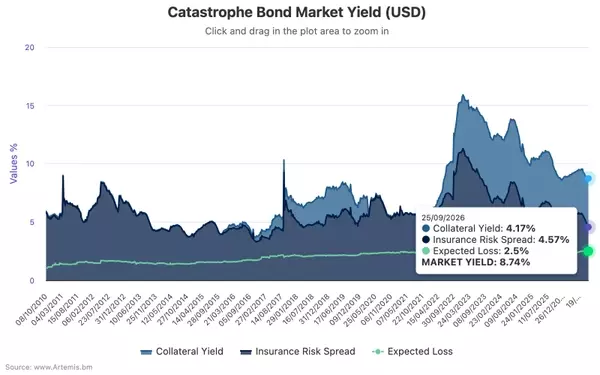
The financial landscape is undergoing a profound transformation, with rising short-term interest rates emerging as a critical factor influencing investment returns, especially within the Insurance-Linked Securities (ILS) sector. This shift is not only enhancing ILS yields but also necessitating a reevaluation of performance attribution across various hedge fund strategies. Don Steinbrugge, a leading expert from Agecroft Partners, underscores the paramount importance of dissecting the true origins of an investment's returns, rather than merely focusing on headline figures. This is particularly relevant as evolving macroeconomic conditions favor certain management approaches over others in delivering superior relative performance.
In a recent analysis, Agecroft Partners' Founder and CEO, Don Steinbrugge, highlighted how the current economic climate disproportionately benefits strategies that maintain substantial liquidity or collateral. This includes quantitative funds, low-net relative-value funds, and, notably, insurance-linked securities. These strategies are experiencing an additional revenue stream from their short-term asset holdings. Conversely, highly leveraged strategies are confronting increased financing costs, which exert significant downward pressure on their overall returns. The dramatic shift from a decade of near-zero short-term interest rates to a scenario where investors can earn meaningful returns on cash and short-term Treasury securities marks a pivotal change in the investment environment. As of September 2026, the Federal Reserve's target for the federal funds rate stands at 3.75% to 4.00%, with further increases anticipated, despite inflation showing a decline from its 2022 peak, yet still above the Fed's 2% target.
The resurgence of significant short-term interest rates carries profound implications for the hedge fund industry. While a common perception links rising rates to declining asset values, Steinbrugge points out that the impact on hedge fund strategies is more intricate. Some strategies are well-positioned to benefit from higher short-term rates, while others face the burden of elevated financing expenses that can considerably erode their returns. This nuance is especially vital for institutional investors. When assessing hedge funds, institutions must look beyond historical performance, volatility, and correlation. They must meticulously examine the underlying sources of return. A strategy that thrived during the zero interest-rate era might exhibit a vastly different expected return profile in an environment where cash yields approximately 4% and the cost of leverage has substantially increased.
Furthermore, quantitative hedge funds are also poised to gain from the renewed vigor in short-term interest rates. Many of these managers employ sophisticated systematic models and algorithms to identify investment opportunities across diverse markets, including equities, futures, currencies, and commodities. A key characteristic of numerous quantitative strategies is their reliance on derivatives for market exposure while maintaining a significant portion of their capital in cash or short-term fixed-income instruments. Quantitative managers may also capitalize on increased market dispersion and volatility. Depending on their specific strategy, these managers can leverage momentum, mean reversion, statistical relationships, market microstructure, and other systematic signals to generate alpha. However, significant variations exist among quantitative strategies regarding holding periods, leverage, liquidity, market exposures, and underlying models. Consequently, institutional investors are advised to delve deeper than historical returns and correlations, focusing instead on understanding the composition of these returns. Distinguishing between returns generated by the core investment strategy and those derived from cash and collateral becomes increasingly crucial as short-term rates climb, enabling a clearer assessment of a manager's genuine alpha-generating capabilities.
Another area where higher short-term rates offer substantial advantages for institutional investors is the global reinsurance market and insurance-linked securities (ILS). Reinsurance strategies involve assuming some of the liabilities of insurance companies, particularly risks associated with property damage from natural disasters such as hurricanes, earthquakes, and wildfires. A primary appeal of this asset class is its relatively low correlation with traditional financial markets, with returns predominantly driven by underwriting results and insured events rather than the direction of equity and bond markets. Higher interest rates provide an additional layer of return. Collateralized reinsurance and insurance-linked securities necessitate capital being held against potential claims until the underlying contracts mature. A considerable portion of this collateral is typically invested in short-term securities. As short-term interest rates ascend, the income generated from such collateral also increases, thereby creating a distinct and attractive return structure. This dual benefit allows institutional investors to derive returns from both the underwriting spread and the yield generated by the collateral supporting the risk. Despite increased competition in the reinsurance market leading to softer pricing across major business lines after a period of robust pricing, the fundamental diversification characteristics of the asset class remain highly relevant for investors seeking sources of return less dependent on traditional financial markets and uncorrelated with Private Credit.
In essence, the prevailing financial climate underscores that short-term interest rates are no longer just a macroeconomic variable but a pivotal component of strategy-level return attribution for hedge funds. Managers who maintain substantial cash and collateral are now benefiting from an additional source of return, a luxury largely absent during the zero-interest-rate era. Conversely, those heavily reliant on leverage are grappling with higher financing costs that can materially diminish their net performance. This dynamic can fundamentally alter the relative economic appeal of different strategies, even if their underlying alpha generation remains constant. Furthermore, elevated rates can foster greater dispersion in the markets, opening new avenues for relative-value and quantitative strategies. For institutional investors, the message is clear: a comprehensive evaluation of a hedge fund must extend beyond its historical net return. It is imperative to understand the origins of that return, discerning how much was generated by alpha versus cash and collateral, the degree of leverage employed, and the strategy's sensitivity to financing costs.