
Search
Stocks

Understanding ETF Expense Ratios: Uncovering Hidden Expiration Dates
Many Exchange Traded Funds (ETFs) come with expense ratios that might seem fixed but often have an expiration date. Fund companies frequently waive or cap fees for a specific period, a detail often buried in the prospectus. Investors need to distinguish between gross and net expense ratios, understand terms like fee waivers, expense caps, and recoupment, and actively check for these hidden end dates to avoid unexpected cost increases in their long-term investments.

Analyzing High-Yield ETFs: Payouts Versus True Investment Gains
The Hidden Cost of Market Calm: BUFR ETF vs. S&P 500
Retirees opting for buffer ETFs like BUFR for market stability might unknowingly sacrifice significant returns. This article reveals that while BUFR effectively cushioned downturns, it left a substantial $62,250 on the table compared to a standard S&P 500 ETF (VOO) over a five-year period for a $300,000 investment. The analysis delves into the mechanisms of buffer ETFs, highlighting how their protective features, such as option-based strategies and dividend exclusion, contribute to this performance gap.

Boosting Retirement Income: ETFs for Inflation-Proof Pensions
Many retirees face the challenge of a fixed pension income that loses purchasing power due to inflation. This article introduces three ETFs—State Street SPDR S&P Dividend ETF (SDY), Vanguard Dividend Appreciation ETF (VIG), and Schwab U.S. TIPS ETF (SCHP)—designed to provide a rising income stream to supplement static pension checks, offering protection against the erosion of buying power.

JEPQ ETF: Understanding the Risks of Bank-Issued Notes
The JPMorgan Nasdaq Equity Premium Income ETF (JEPQ) relies significantly on equity-linked notes (ELNs) issued by financial institutions to generate its monthly income. While providing substantial options premiums, these notes introduce counterparty, liquidity, and cost risks, potentially exposing investors to principal loss. This article delves into the inherent risks associated with JEPQ's structure, contrasting it with direct index investments and urging investors to thoroughly assess their overall financial exposure.
Amplify's Dividend Fund Outperforms QYLD Over Five Years
This report compares the five-year performance of two covered-call ETFs: the Amplify CWP Enhanced Dividend Income ETF (DIVO) and the Global X Nasdaq 100 Covered Call ETF (QYLD). While both offer monthly income, DIVO significantly outperformed QYLD over a five-year period, returning 67.09% compared to QYLD's 49.71%. The article highlights the differing investment strategies of the two funds and discusses factors like reinvestment, recent performance, and the tax implications of return of capital.
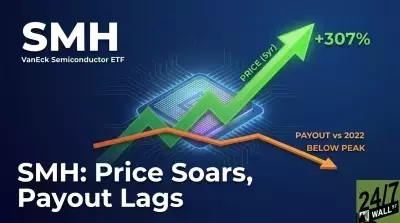
SMH ETF: Soaring Price, Stagnant Payouts
The VanEck Semiconductor ETF (SMH) has seen its price surge by an impressive 307% over five years, yet its dividend payouts have not kept pace. Despite robust growth in asset value, the fund's annual distribution per share, even after a 2023 stock split adjustment, remains below its 2022 peak. This discrepancy highlights a critical consideration for investors, particularly retirees seeking consistent income: while capital appreciation has been substantial, the income generated from dividends offers a remarkably low yield, driven by the reinvestment strategies of its major semiconductor holdings.
Fidelity's Dividend ETF Outperforms JEPI Amidst Federal Reserve Rate Decisions
As the Federal Reserve's October 28 rate decision approaches, investors are evaluating the performance of dividend ETFs. Fidelity's Dividend ETF for Rising Rates (FDRR) has significantly outperformed JPMorgan Equity Premium Income ETF (JEPI) over the past year and five years, returning 19.12% versus JEPI's 7.17%. This raises questions for JEPI holders about potential portfolio adjustments, especially considering Fidelity's fund is designed for rising interest rate environments.

Understanding Tax Implications for Gold ETF Investments
Investing in gold through exchange-traded funds like GLD might seem straightforward, but the Internal Revenue Service categorizes gains from such investments as 'collectibles,' subjecting them to a potentially higher tax rate of up to 28%. This contrasts sharply with the lower capital gains rates typically applied to stock ETFs. This article delves into the critical tax distinctions that investors need to be aware of when considering gold-backed ETFs, highlighting how a significant profit, like a $162,713 gain on a $300,000 sale, can lead to unexpected tax liabilities.

High-Dividend, Low-Volatility ETF Underperforms S&P 500: A Comparative Analysis
This analysis compares the performance of Invesco S&P 500 High Dividend Low Volatility ETF (SPHD) and Vanguard S&P 500 ETF (VOO) over five years, from October 2021 to October 2026. A $300,000 investment in SPHD yielded $436,740, significantly less than the $542,040 generated by VOO, creating a $105,300 difference. While SPHD offers lower volatility and higher dividends, its growth lag raises questions for investors prioritizing overall returns. The article details the trade-offs between stability and capital appreciation.

Understanding ETF Performance: A Comparative Analysis of Equal-Weight vs. Cap-Weighted S&P 500 Funds
This article explores the performance disparities between the Invesco S&P 500 Equal Weight ETF (RSP) and the iShares Core S&P 500 ETF (IVV). Over five years, RSP significantly underperformed IVV, but over one year and year-to-date, RSP showed stronger returns. The analysis highlights how different market conditions favor each weighting strategy and provides guidance on selecting the appropriate fund based on investor preferences for concentration and risk.
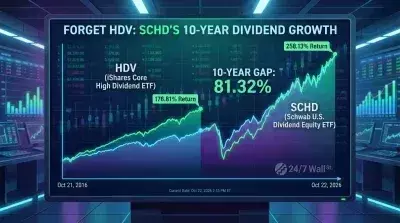
SCHD vs. HDV: A Decade of Dividend ETF Performance Discrepancies
This analysis compares the performance of two prominent dividend-focused Exchange Traded Funds (ETFs), SCHD and HDV, over different timeframes. While SCHD significantly outperformed HDV over a ten-year period, delivering a 258.13% return compared to HDV's 176.81%, the roles reversed in the most recent five years, with HDV leading SCHD. The article highlights how varying measurement periods can drastically alter the perceived winner between these two funds, emphasizing the importance of aligning investment choices with individual financial goals and considering tax implications.