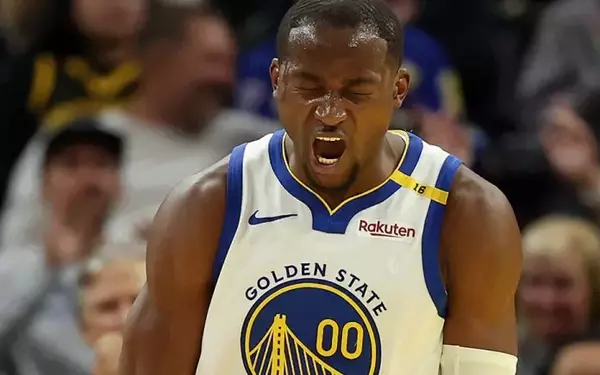
The contract negotiations between promising forward Jonathan Kuminga and the Golden State Warriors have reached a critical juncture, with both parties holding firm on their respective proposals. The central disagreement revolves around control and long-term flexibility, as Kuminga seeks a player option for future autonomy, while the Warriors aim to maintain team control through a team option or potentially explore sign-and-trade options if no agreement is reached before the October 1 deadline.
Contract Stalemate: Jonathan Kuminga and Golden State Warriors Reach Impasse Over Future Control
A significant contract standoff has emerged between the Golden State Warriors and their forward, Jonathan Kuminga, as new information regarding Kuminga's counter-offer has been brought to light. According to reports from ESPN's Shams Charania and Anthony Slater, Kuminga's representatives recently put forth a one-year \"bridge\" deal. This proposal was designed to provide Kuminga with a more substantial financial package than the standard $7.9 million qualifying offer, while simultaneously securing his unrestricted free agency for the following summer. A key component of this offer was the removal of the inherent no-trade clause typically associated with a qualifying offer, which would grant the Warriors greater flexibility to potentially trade Kuminga as an expiring contract closer to the trade deadline.
However, Warriors owner Joe Lacob has reportedly expressed strong reservations about this concept, citing concerns over the team's potential inability to secure Kuminga long-term if he enters the free-agent market without any restrictions in 2026. In response, the Warriors' front office, under the leadership of Mike Dunleavy Jr., presented a three-year contract valued at $75.2 million. This offer included a team option for the third year, with $48.3 million guaranteed for the initial two years, a financial structure that mirrors Josh Giddey's recent contract with the Chicago Bulls. An alternative offer from the Warriors involved a fully guaranteed three-year, $54 million deal, notably without a player option.
The primary point of contention for Kuminga and his agent, Aaron Turner, continues to be the inclusion of a player option. They have consistently advocated for this provision, even suggesting a willingness to accept a slightly lower annual salary closer to $20 million if a player option is included. Conversely, the Warriors remain steadfast in their insistence on a team option. Kuminga's camp views this as a potential indication that the team might be more inclined to treat him as a trade asset rather than a foundational piece for their future. The 22-year-old Kuminga is coming off a career-best season, where he averaged 15.3 points and 4.6 rebounds per game, demonstrating significant athleticism and defensive versatility, which proved crucial for the Warriors during periods when key players like Stephen Curry, Jimmy Butler, and Draymond Green were sidelined.
Despite public statements of support from ownership, league sources suggest that the Warriors are open to exploring sign-and-trade scenarios if a mutual agreement cannot be reached. While the Sacramento Kings have reportedly shown exploratory interest, the Brooklyn Nets have withdrawn from earlier discussions. With the October 1 deadline for the qualifying offer rapidly approaching, the negotiation process is entering a critical stage. Should a compromise fail to materialize, Kuminga may choose to play under the qualifying offer, prioritizing short-term flexibility, which could leave the Warriors facing the prospect of losing a valuable young talent in the near future without receiving any assets in return.
This contract dispute highlights the complex dynamics between player empowerment and team control in professional sports. For the Warriors, balancing their desire to retain Kuminga's talent with their long-term roster planning and financial flexibility is crucial. For Kuminga, the decision involves weighing immediate financial security against the potential for greater autonomy and a more lucrative long-term deal in the future. The outcome of these negotiations will undoubtedly have significant implications for both Kuminga's career trajectory and the Warriors' competitive standing in the upcoming seasons.