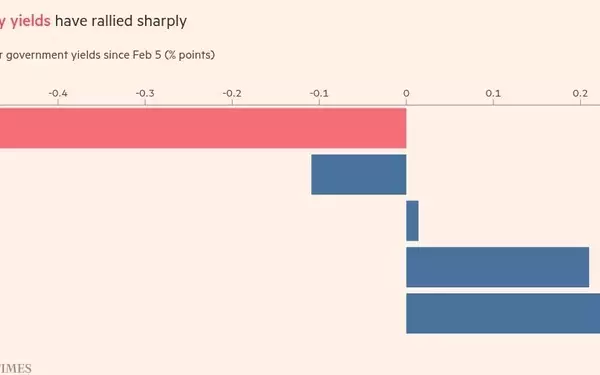
Amid the introduction of stricter tariffs by President Donald Trump, municipal bonds experienced a notable rally while U.S. Treasuries saw a decline followed by a modest recovery. This economic shift affected equities negatively for two consecutive days. Barclays strategists Mikhail Foux and Grace Cen noted that March was challenging for munis, pushing investment-grade index returns into negative territory in Q1. However, April has been more promising for fixed-income products as U.S. Treasury yields have decreased significantly in response to tariff measures. The market sentiment shifted dramatically post-election, with investors now pricing risk more cautiously.
Market Dynamics Reflecting on Fixed-Income Products
In the midst of a vibrant spring season, financial markets faced turbulence due to unexpected tariff announcements. On a Friday morning, municipal bonds gained momentum, contrasting with an initial dip in U.S. Treasuries. Subsequently, Treasuries regained some ground, finishing the day on a firmer note. Meanwhile, stocks closed lower for the second day running after President Trump unveiled more stringent tariffs than anticipated. According to Barclays analysts, March proved particularly difficult for municipal bonds, dragging down the performance of the investment-grade index throughout the first quarter. Yet, April commenced positively for all fixed-income assets, as U.S. Treasury yields dropped between seven to nineteen basis points over two trading sessions.
This movement was attributed to the harsher-than-expected tariffs. Municipal bonds extended their two-day upward trend, with AAA yields rising between eighteen to twenty-four basis points since Thursday. Thornburg Investment Management's Christian Hoffmann highlighted that pre-election optimism had masked underlying risks until they became unavoidable. The tariffs injected uncertainty and volatility reminiscent of the pandemic's early stages, noted Matt Burdett from Thornburg Equities. Despite this upheaval, fixed-income reactions were less dramatic compared to equities, showing a flight-to-quality toward U.S. Treasuries and munis.
The March jobs report revealed stronger-than-expected figures, adding 228,000 jobs during the month. Nevertheless, economists argued it had minimal impact on market movements overshadowed by tariff developments. Bloomberg BVAL data indicated adjusted yields ranging from eight to eleven basis points across different maturities. Similarly, ICE Data Services reported shifts in AAA yield curves, reflecting broader market sentiments.
New issuance schedules for the week starting April 7 totaled approximately $10.686 billion, comprising negotiated and competitive deals. Notable offerings included New York City issuing $1.57 billion in GOs, Bon Secours Mercy Health offering hospital facilities revenue bonds worth nearly $900 million, and Anne Arundel County leading competitive sales with $419 million in GOs.
Perspective on Market Behavior and Future Outlook
From a journalistic standpoint, these events underscore the complexity of modern financial markets where geopolitical decisions ripple through various asset classes. Investors must navigate an increasingly uncertain landscape marked by shifting trade policies and their macroeconomic implications. While municipal bonds appear attractive in certain segments, challenges persist due to high net issuances expected this month. Economists caution against overestimating potential Federal Reserve rate cuts amidst robust labor market data but acknowledge growing recession risks tied to tariffs.
This episode serves as a reminder of how interconnected global economies are today, emphasizing the need for agile strategies capable of adapting swiftly to sudden changes. As we move forward, monitoring both domestic and international developments will remain crucial for maintaining portfolio resilience amid volatile conditions.