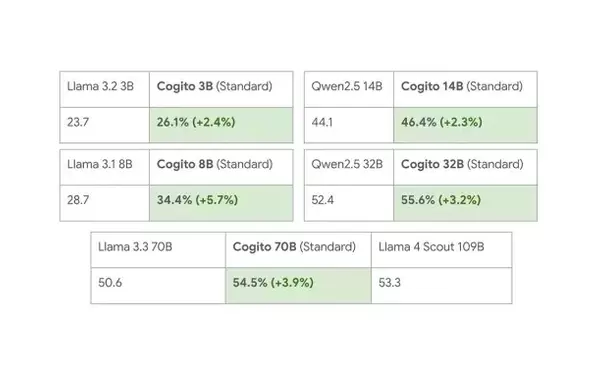
A groundbreaking development in artificial intelligence has emerged from the San Francisco-based company, Deep Cogito. The organization, committed to constructing general superintelligence, recently introduced a series of large language models (LLMs) with parameter sizes ranging from 3B to 70B. These models demonstrate superior performance compared to existing open-source alternatives and highlight advancements in computational efficiency and scalability.
Innovative training techniques lie at the heart of this breakthrough. Deep Cogito employs a novel methodology called Iterated Distillation and Amplification (IDA), which represents a scalable strategy for enhancing model alignment. This method involves two pivotal steps—amplification and distillation—that create a positive feedback loop. Amplification leverages additional computation to refine the model's capabilities, while distillation integrates these improvements back into the model’s architecture. By iterating these processes, IDA enables models to surpass limitations typically imposed by human curators or larger overseer models.
The newly launched Cogito models showcase impressive versatility and optimization for various applications, including coding, function calling, and agentic scenarios. A standout feature is their dual functionality, allowing them to either provide direct answers or engage in self-reflection before responding. Benchmarks indicate that these models outperform competitors across different sizes and modes, particularly excelling in reasoning tasks. Despite acknowledging the limitations of benchmark evaluations, Deep Cogito remains confident in the practical utility of its models. With plans to release enhanced versions and even larger mixture-of-expert (MoE) models, the company continues to push the boundaries of what is possible in AI development.
This remarkable achievement underscores the potential of innovative methodologies like IDA to revolutionize the field of artificial intelligence. As Deep Cogito progresses along its scaling curve, it exemplifies the importance of iterative improvement and collaboration in advancing technology. By fostering openness and sharing knowledge, the company inspires others to contribute to the collective pursuit of creating smarter, more efficient systems that benefit society as a whole.