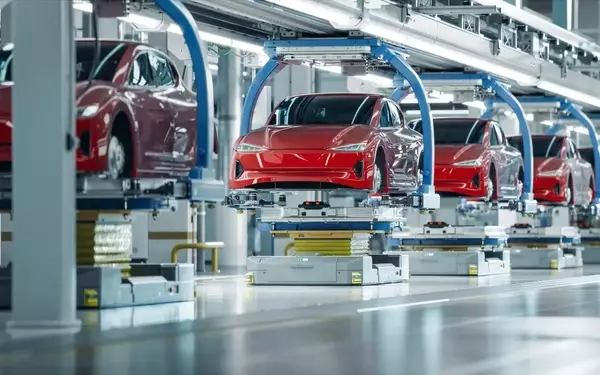
Rivian recently concluded a robust second quarter, showcasing remarkable enhancements in various financial indicators. The electric vehicle producer commenced R2 unit deliveries on June 9th, resulting in an additional $100 million in cost of revenue due to production ramp-up. This article delves into the factors positioning this emerging EV company for substantial growth, extending beyond the anticipated success of the R2 model.
A critical element for Rivian's ambitious delivery goals and production expansion is the successful implementation of a second production shift. Having delivered 10,365 vehicles in the first quarter and 12,194 in the second, totaling over 22,500 units, Rivian recently elevated its full-year delivery forecast to between 65,000 and 70,000 vehicles. Management highlighted significant advancements in training new personnel and optimizing processes during the R2's initial shift, with expectations to operate with two shifts by the end of the third quarter. While the R2 generates considerable excitement and is a primary driver of Rivian's expansion, it is not the sole contributor to the company's forward momentum.
Achieving gross profit stands as one of Rivian's most significant recent achievements, distinguishing it from competitors like Lucid, which have struggled with scaling and improving vehicle unit economics. The consolidated gross profit reached $179 million in the second quarter, marking a substantial $385 million increase year-over-year. Although the automotive segment incurred a $36 million loss, largely due to the R2 production ramp's incremental costs, this was largely mitigated by the software and services division, which reported a $215 million gross profit with an impressive 42% margin. This success is partly attributable to a joint venture with Volkswagen, which accounted for 60% of software and services revenue in the second quarter, alongside growth in vehicle repair, maintenance, and Autonomy+ (Rivian's advanced driverless technology). Rivian is confident that Autonomy+ will serve as a key differentiator, enhancing its market position against other EV manufacturers.
Rivian's recent performance highlights a company on the cusp of significant expansion, fueled by strong financial results, strategic capital infusions, and an expanding ecosystem of software and services. The company's enhanced liquidity, bolstered by $5.31 billion in cash, equivalents, and short-term investments at the close of the second quarter, and an additional $1.3 billion raised through Class A shares in July, positions it for continued growth. Furthermore, an anticipated $1 billion in non-recourse debt from Volkswagen and a $250 million equity investment from Uber, alongside a Department of Energy loan, are expected to boost future capital to approximately $14 billion. This robust financial standing, coupled with an innovative product roadmap and a focus on cutting-edge technology, not only secures Rivian's competitive edge but also underscores its commitment to sustainable development and technological leadership in the electric vehicle industry, paving the way for a transformative future.