Amid mixed economic signals and shifting market expectations, long-term government bonds experienced a challenging day on Wednesday. The Treasury Department's decision to maintain its debt issuance guidance for the foreseeable future disappointed some investors who had hoped for more aggressive measures to support longer-maturity bonds. Economic data revealed both contractionary and inflationary trends, further complicating the Federal Reserve's policy path.
Details of the Market Fluctuations
In the midst of a golden autumn for financial markets, yields on 30-year bonds climbed by three basis points to reach 4.68%, while those on two-year bonds fell slightly by two basis points to settle at 3.62%. This divergence was fueled by weaker-than-expected GDP figures juxtaposed with unexpectedly robust consumption data and elevated prices. The Treasury maintained its stance on keeping the issuance of longer-dated securities constant for several quarters, hinting at a potential enhancement in its buyback program.
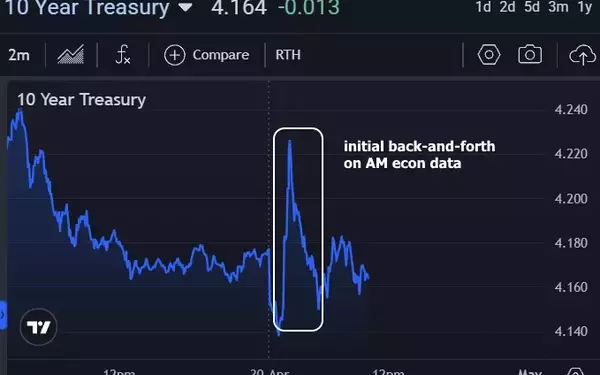
The 10-year yield saw a significant fluctuation, jumping as much as five basis points to 4.23% following the release of economic data and the Treasury’s quarterly refunding announcement. Although this movement later moderated, it underscored the heightened volatility within the market. In its statement, the Treasury outlined plans to sell $125 billion worth of securities during the upcoming auctions scheduled for next week, encompassing maturities of 3-, 10-, and 30-years.
While the Treasury’s guidance aligned with many investors’ anticipations, some analysts, including those at Citigroup, had expected more assertive actions to alleviate concerns over supply. Wells Fargo strategists Angelo Manolatos and William Gibbons noted that the market's reaction suggested unmet expectations regarding enhanced liquidity support or discussions about shortening the weighted average maturity.
The underperformance of long bonds widened the yield gap between five- and 30-year bonds by four basis points to 92 basis points. This steepening has been a recurring theme in the bond market, driven by traders' expectations that an economic slowdown would eventually prompt the Federal Reserve to lower borrowing costs, even as inflation and bond supply keep long-end yields elevated.
Data from Wednesday highlighted a contraction in the US economy at the beginning of the year, the first since 2022, due to a surge in pre-tariff imports and reduced consumer spending. Additionally, underlying inflation accelerated to a 3.5% pace in the first quarter, marking the highest rate in a year.
Market Insights and Future Expectations
From a journalistic perspective, this scenario underscores the complexities of modern financial markets where multiple forces—economic data, central bank policies, and fiscal decisions—interact in intricate ways. Investors must navigate through periods of uncertainty, balancing optimism with caution. The forthcoming US jobs report could provide further clarity, potentially influencing bets on interest-rate cuts by the Federal Reserve. Ultimately, the interplay between economic indicators and policy responses will continue to shape the trajectory of bond markets and broader financial landscapes in the months ahead.