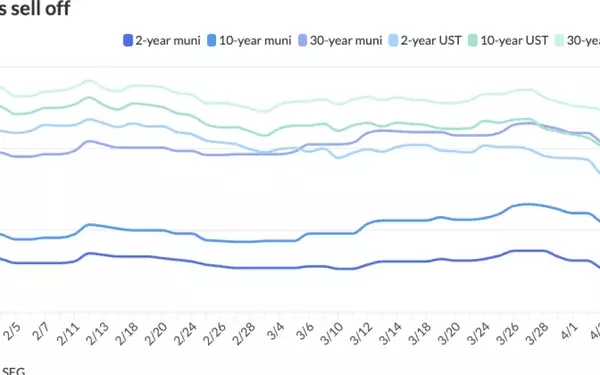
In a day filled with unpredictability, the bond market experienced significant fluctuations on Monday. Initially starting near its lowest yields of the year, the market quickly shifted to heavy selling, leading to an unexpected 17bp rise in 10-year yields. This volatility left experts baffled as they tried to identify contributing factors from a list that included inflation concerns tied to trade policies, budgetary impacts due to reduced tariff revenue necessitating increased Treasury issuance, cautious buyers ahead of auctions, fears of declining foreign bond purchases, and a shift towards cash by traders seeking new opportunities amid recent market chaos. Economic data releases such as Jobless Claims, Continued Claims, and ISM Services also played a role in influencing market sentiment.
A Closer Look at Monday's Bond Market Rollercoaster
On a seemingly ordinary Monday in early April, the bond market embarked on an extraordinary journey. In the golden hours of dawn, yields were hovering near their yearly lows. However, as daylight unfolded, a wave of aggressive selling swept through the market. By mid-morning, mortgage-backed securities (MBS) had dropped three ticks while the 10-year yield climbed six basis points to reach 4.065%. The situation worsened further when headlines hinted at a "tariff pause," causing additional losses; MBS fell by three-eighths and the 10-year yield surged 14.4bps to 4.151%. As the trading day drew to a close, despite a brief recovery, the market returned to its weakest levels with MBS down nearly five-eighths and the 10-year yield rising 16bps to settle at 4.165%.
Economic indicators released throughout the day added another layer of complexity. The Jobless Claims report came in lower than expected at 219k, while Continued Claims rose slightly above forecasts to 1.903 million. Additionally, the ISM Services index dipped significantly to 50.8, reflecting a contraction in the sector. These figures underscored a mixed economic landscape that contributed to investor uncertainty.
From a journalist's perspective, this event highlights the interconnected nature of global markets and the far-reaching implications of geopolitical decisions. It serves as a reminder that even in an era of advanced analytics and predictive modeling, the human element—fear, speculation, and reaction—remains a powerful force shaping financial landscapes. For readers, it emphasizes the importance of staying informed and adaptable in an ever-changing economic environment.