Market Shift: Investors Abandon Stocks for Bonds Amid Tariff Uncertainty
·5 min read
Advertisement
The stock market's optimism following the election has faded as President Trump's new tariffs have investors rethinking their strategies. With bond yields dropping and economic growth concerns mounting, traders are now focusing on the broader implications of these trade policies. This shift marks a significant departure from earlier predictions that tariffs would fuel inflation.
Prepare for Market Turbulence: A Strategic Move to Bonds
Equities Under Pressure: The Stock Market Retreats
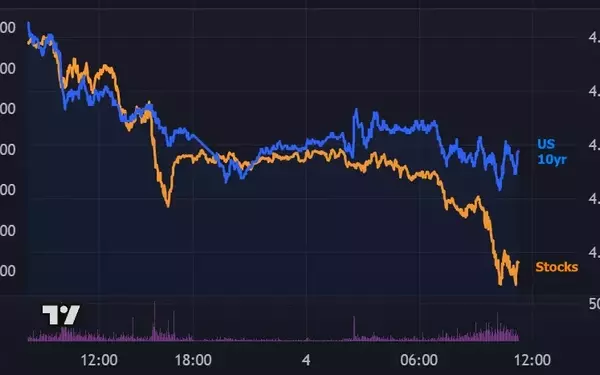
The stock market experienced a notable downturn as the impact of recent tariffs began to take hold. Major indices like the S&P 500 and Nasdaq 100 saw sharp declines, erasing gains made since the election. Investors grew wary of the potential repercussions on global trade and economic stability. For instance, the S&P 500 fell by 2%, reaching an intraday low of 5,732.59, effectively wiping out the post-election rally. Similarly, the Nasdaq 100 dropped 1.9% to 20,034.68, signaling a correction in the tech-heavy index.These movements reflect growing concerns about the sustainability of corporate earnings and consumer spending in an increasingly uncertain trade environment. Analysts point to the fact that tariffs can lead to higher input costs for businesses, which may be passed on to consumers, thereby dampening demand. Moreover, the psychological impact on investor sentiment cannot be understated. As uncertainty looms, many are choosing to safeguard their portfolios by shifting away from equities.
Bond Rally: A Safe Haven in Volatile Times
In contrast to the stock market's decline, government bonds emerged as a safe haven for investors. Yields on the 10-year Treasury note fell by as much as 5 basis points to 4.104%, indicating increased demand for this traditionally stable asset. This trend underscores a shift in market sentiment, where concerns over economic growth have taken precedence over inflationary pressures.Initially, when the tariff plans were announced, bond yields spiked due to fears of inflation. However, recent economic data has painted a different picture. Softening indicators suggest that the economy might be slowing down, leading investors to reassess their risk tolerance. The Brookings Institution estimated that the initial tariff plan could reduce GDP growth by approximately a quarter-percentage point. Given this context, the move toward bonds reflects a cautious approach in anticipation of slower economic activity.
Economic Indicators Signal Caution
Several key economic indicators are pointing to a slowdown, further reinforcing the shift in investment preferences. GDP growth is expected to contract this quarter, with projections indicating a decline of 2.8%, according to the Atlanta Fed’s GDPNow model. Manufacturing activity, which is crucial for overall economic health, has shown signs of weakness. Although the sector expanded marginally in February, the New Orders Index dipped below 50, signaling contraction.Consumer confidence also took a hit, experiencing its largest monthly drop in nearly four years. Additionally, more consumers now view a recession as a likely scenario within the next year, according to the Conference Board. These trends highlight the growing unease among both businesses and households. Michael Brown, a senior research strategist at Pepperstone, noted that weak economic data is bolstering the case for bonds, as investors seek to de-risk their portfolios.
Geopolitical Factors Amplify Market Anxiety
The Trump administration’s aggressive stance on trade and geopolitics has added another layer of complexity to the market landscape. Doubling down on tariffs and adopting a hawkish approach without the safety net of Federal Reserve support has created a challenging environment for equities. Boris Kovacevic, a global macro strategist at Convera, observed that investors are continuing their shift from stocks to bonds in response to disappointing data and geopolitical tensions.This combination of factors—economic softness, trade uncertainties, and geopolitical risks—has led to a grim short-term outlook for equities. As markets adapt to these changing dynamics, the strategic reallocation of assets towards safer investments like bonds becomes increasingly prudent. Investors are preparing for a period of volatility and are positioning themselves accordingly to navigate the uncertainties ahead.